

dirt and glory
She told me about the night air. How it was soaked in sweat and smoke. Music was felt rather than heard and the world was dirt cheap compared to now.


‘There was thunder inside the clubs back then; you could feel it in the pit of your stomach’
Auburn, late August, 2005
Clean air brushes her face - she’s across from me, cheek against the pillow. Her skin is warm and smells like the velvety insides of iris with something clean mixed in. Always clean. Always recognizably her. Yet an old pashmina scarf of hers I keep buried inside the back of a draw smells different. It smells of dirt, colour and concrete. It’s faint but there. And when I inhale I sense that the notion people don’t change is incorrect.
*
Home was built around the American River and passed down through a lineage I didn’t fully trust. Some grandfather came west chasing gold and ended up with land instead. My connection felt haphazard and I could never recognize the bounty in my lap. For me, the waterways consisted of a thick black sludge, running so far ahead I could no longer tell where they began or ended.
When summer came the air turned to syrup. I would lay awake on sheets so crisp they sliced into my back, then eventually curl into the fetal position and feel the elusive shape of nothingness somewhere inside my gut. I decided wanted nothing more than to shit it out.
Dirt blew in quietly through an open window, and turned the inside to outside. I waited for the following day, which would inevitably sprawl out like an old and tired panting dog. By morning that dog would trail behind my heels waiting for a tell I couldn’t give.
*
She told me about the night air in New York, how it was soaked in sweat and smoke. Music was felt rather than heard and the world was dirt cheap compared to now. So cheap you could return home with only physical regret, rather than purely financial. Eventually, the sun would crawl out from behind all that dense concrete and hair. As the hours loosened their grip on the earth and morning climbed higher, what slipped down open throats was belonging. Honey-coloured and so rich it carried enough sustenance to endure the repression and confinement until the next one. For some it was next Saturday, but for her it was the following night.
*
The rivers were in my bloodstream now, so much so that whenever I left them she would jokingly press a flask of river water into my hands.
*
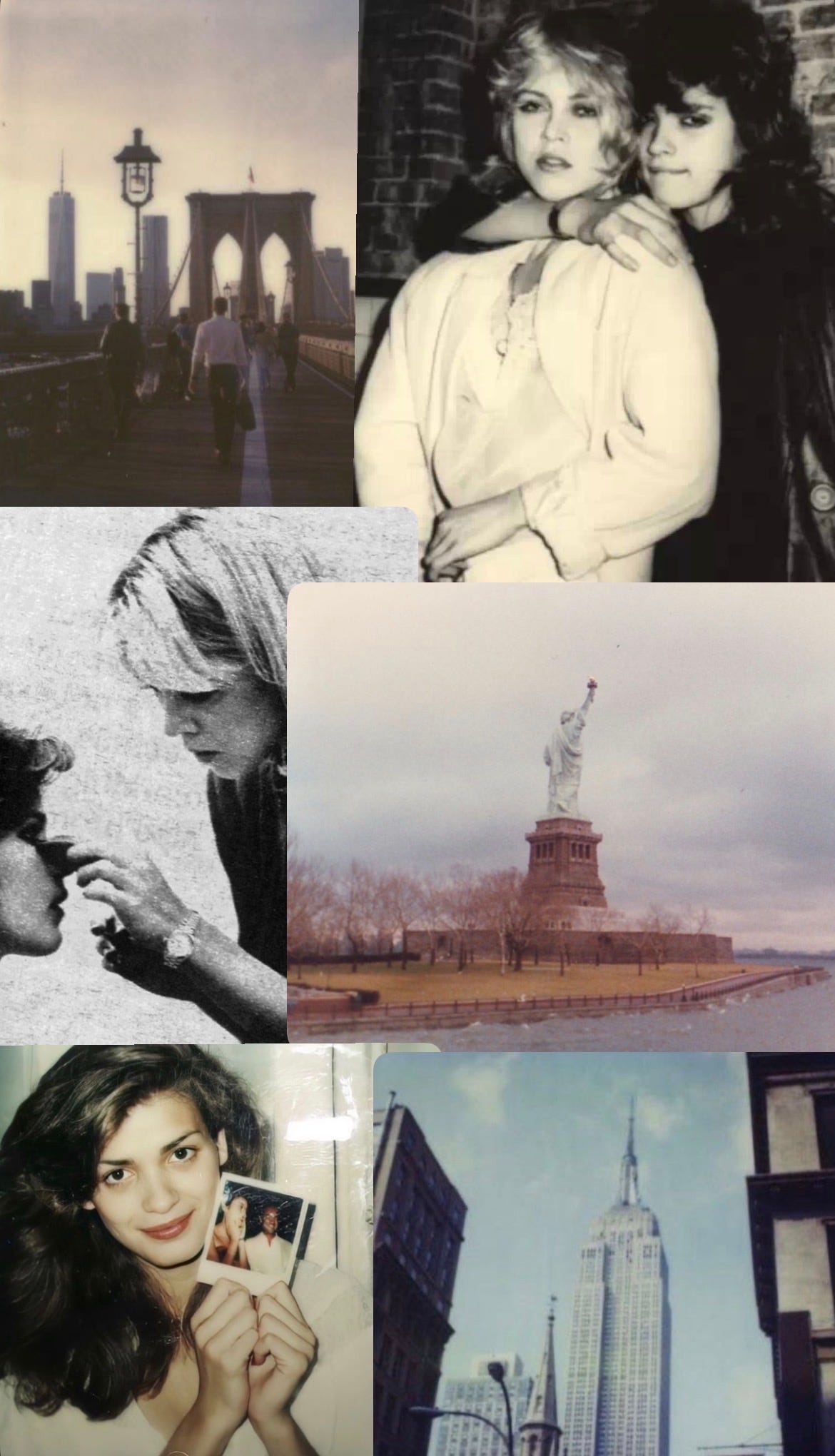
I flicked through her old Polaroids — fleshy pink and white with age. They loosely documented a time before everything was digital, before time became something you could choke on. I could see a looseness beneath the strobe lights, one I couldn’t fathom and one I couldn’t imagine belonging to. She pointed to garments which seemed too expressive now, too ridiculous. ‘You could get away with that then,’
I gathered that so much nuance slipped between those acetone sheets. Somehow she was there, amongst clashing coloured fabrics and people momentarily free. She wasn’t flamboyant or eccentric. But instead she was palatable, eighteen and vivacious. She could be in the vicinity of whoever and mould herself to whatever the moment demanded. A friend had taken opportunity of that - he had taken her as a way in, and perhaps also a human shield if his plan to find belonging caved inward.
I heard about how the club scene was this convergence of colour and diversity. A society of microcosms, brushing against one another while the larger world quietly took what it wanted. I heard that almost every night a guy would pull her into a grimy bathroom stall of some club, open his mouth and point to a sore, asking if he was dying. She would tell him incoherently but sincerely that she wasn’t a doctor - just a medical student. She was also eighteen and felt he should see someone else, because she didn’t know if the sore meant anything or not. But the more she looked, the more she felt it did. And then the night would end. The ends were where we found common ground. I felt my proximity to her shaped into something tangible. She described being left on some pavement somewhere, with dirt under her nails and half her eyelashes missing.
I look at her now. Her skin is golden at the edges from sun. She’s standing in the kitchen of the house she bought at thirty. There’s a kind of heat in the air that slathers over you and presses into everything. The kind that makes you accept sleep won’t be possible tonight.
She’s older - wrinkles at her eyes like primaries on a dove wing. But occasionally I heard her as she had been - clumsily garbling out under a deafening synth that she was straight.
* Last night, I heard her on the phone. She was piecing back the mosaic of nights in 1982. She was speaking to a man whose words drawled. Luscious effeminate vowels not heard from our world built around pastures and rivers. Why didn’t I have the drive which seemed to have been instilled inside of her at fourteen? While I was cultivating my experiences inwardly, she was out there — ravenous for experience and the unnecessary tension which followed. I read somewhere that Epicurus argued the greatest pleasures come from moderation: friendship, knowledge, and freedom from anxiety rather than excessive luxury. She didn’t like this, and told me to cultivate outwards rather than inwards. Her thumb beneath my chin.
She tells me how you could feel the dirt rising up from pavements, like how the horses back in Auburn whipped up sand and grit from the earth. New York dirt sounded different from our dirt. Our dirt was pure, undisturbed and clean in a way.
*
Auburn, late August, 1980
There was no shelter from the vastness of sky.
Her grandmother liked it and she spoke of insignificance as something comforting, like an antidote for meaning, or lack thereof. Perhaps because the village she came from layered meaning upon meaning into every mannerism, every thought, every glance. The air was thick with meaning and, by the time summer came, so torrid and dry that being swallowed by the sky, rather than living beneath it, made surrender feel more appealing than resistance.
Before New York, before she left her grandmother, she had the same recurring dream. One where the suburbs of Auburn would tip upside-down, losing grip on the earth.
Eventually everyone would fall into this pit of black and silver light. And as the sun came up, silver would gradually become a deep rich amber, engulfing home, the mountains and the scraps of meaning which had emerged from the pools her grandmother said were rarer than gold.
*
It took time for me to realize she hadn’t been in New York for hands or eyes. She had been there because the tower blocks made the sky seem smaller, forcing meaning to be cultivated from scratch. Inside her bedroom back in Auburn, night would come in quick and nothing would stop it. If she opened up her window, it was black. In New York, it was colour. Iridescent and full. Meaning transitioned into something else entirely. She could never decide what that looked like. Maybe a giant shape billowing above the skyscrapers, like a shield between her and the solar system.
Not an empty statement hollowed out, arbitrary and devoid of meaning. It wasn’t freedom exactly or even acceptance. It was an amalgamation of words densely packed together so none of them could breathe or change.
OMG. You have just described my youth in New York. Such a gritty, magical time. You would have loved it.
this felt less like reading an essay & more like inheriting someone's memories for a little while. "she had been there because the tower blocks made the sky seem smaller" is going to stay with me for a long time💚💚